
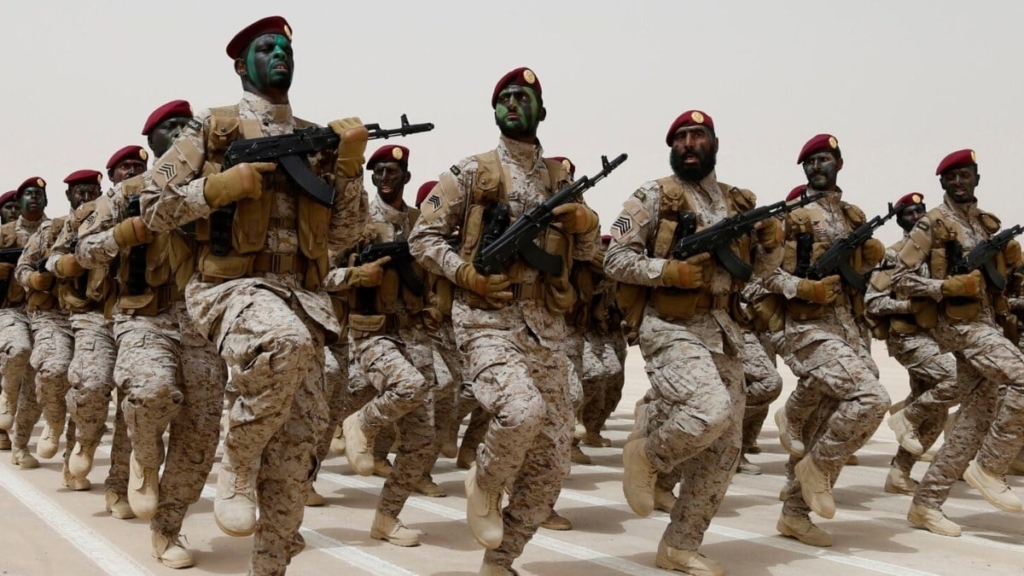
The Economist is a UK-based magazine that recently discussed the military powers of Arab countries. The analysis pointed out that the governments in the Arab region “lavish money, but this does not help to elevate the reputation of their military forces.” It was noted that the region’s air defense systems received “high praise” when they helped deflect Iran’s attack on Israel in April. However, despite such instances of success, Arab states do not receive praise for their military skills since many are said to have “poor military reputations.”
The analysis highlighted that during the 1991 Gulf War, Arab countries proved to be ineffective. Recently, despite significant American military support, the Saudi-led intervention in Yemen turned into a quagmire. The issue was not about lack of funds or equipment. The total annual military expenditure of the six Gulf Cooperation Council countries, along with Egypt and Jordan, is just over 120 billion dollars. European NATO members, on the other hand, spent 380 billion dollars in 2023. Together, they can deploy 944 thousand troops, 4,800 tanks, and a thousand fighter jets. Egypt and Jordan are among the biggest recipients of American military aid, receiving around 1.7 billion dollars annually.


The majority of this money is seen as “wasted,” with Arab armed forces often spending on flashy equipment that is not suitable for the asymmetric threats they face. These ostentatious purchases are often used to gain influence over Western governments. Qatar’s acquisition of F-15, Rafale, and Typhoon aircraft garnered praise in Washington, Paris, and London, respectively. It was noted that in Saudi Arabia, 54% of the value of arms imports over the last decade was spent on aircraft, displaying an obsession with airpower at the expense of other arms of service like the army and navy.
The analysis indicated that the fixation on airpower occurred partly due to the authoritarian nature of Arab military leaders. It was pointed out that Arab armies are often treated as “guardians.” Examples were provided to illustrate this point, such as Saudi Arabia’s National Guard of 130,000, which serves as the ruling family’s protection force. In Egypt, the army manages a vast commercial empire that extends from holiday resorts to construction companies. While some hope that Arab armies could provide peacekeeping forces in Gaza, experts doubt their operational capabilities for engaging in high-level conflicts.
According to the analysis, Arab armies often struggle to work together and lack mutual trust. Many Arab leaders prioritize securing America’s commitment to the region over forming a multilateral bloc. Gulf countries heavily rely on America’s intelligence, surveillance, and reconnaissance capabilities. The Saudis particularly pursue defense agreements with the US persistently.